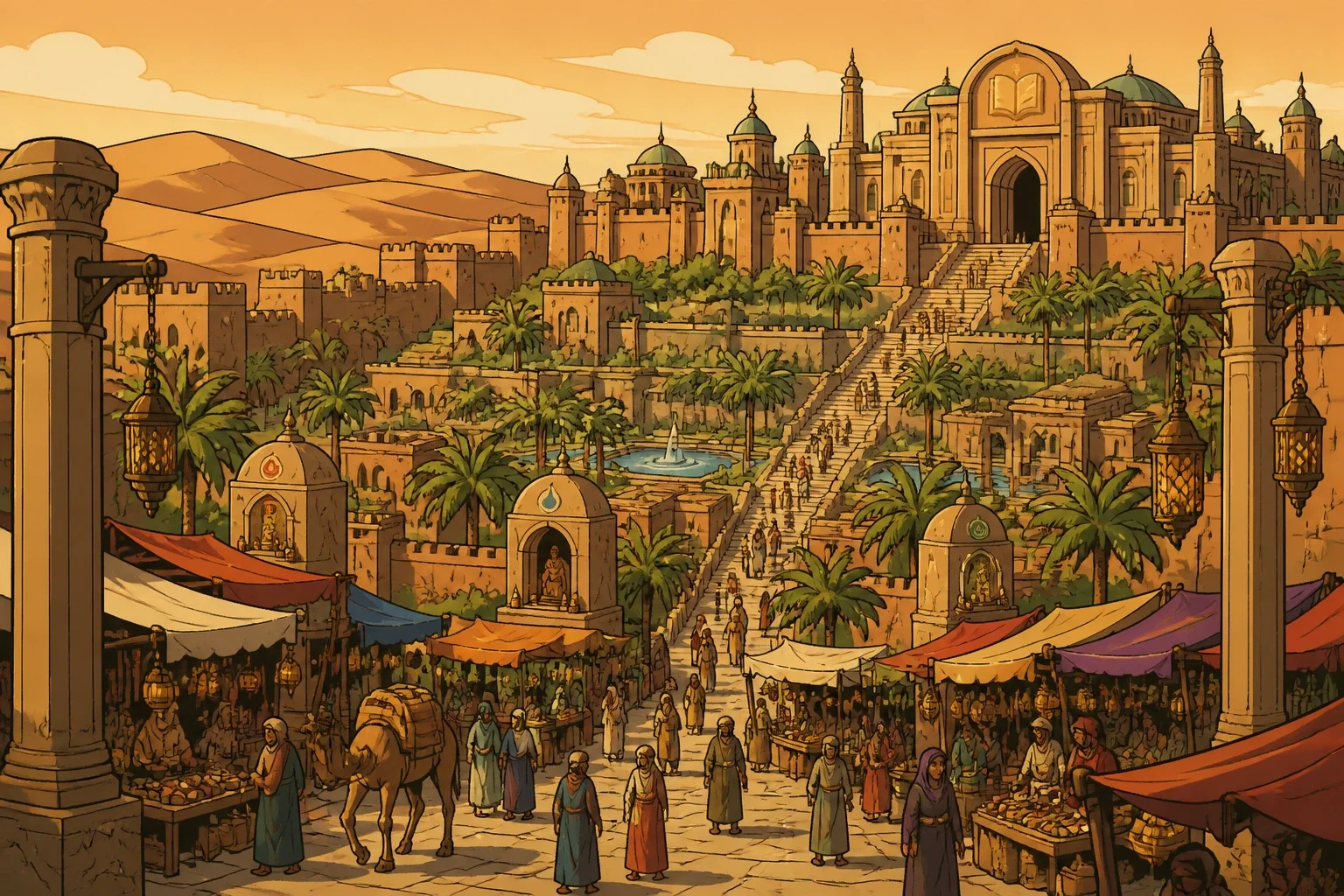
Khasim's Crown is a sprawling clay-built city hidden in the deep dunes east of the Witchwood, home to roughly 50,000 souls. Tiered terraces step down from its high outer walls toward a chain of oases scattered through its heart, and its rooftops, awnings, and cisterns are all the same warm ochre as the sand around it. Date palms shade the streets, bronze lanterns hang from the colonnades, and the markets run loud from sundown until well past dawn.
Worship of every god is permitted within the walls, and shrines to a hundred faiths are tucked between archways and along the oasis paths. Seraphis, god of knowledge, is the city's patron, and his sigil is carved above the doors of the Lyceum.
The Lyceum and the Senate
Civic life in Khasim's Crown turns on the Lyceum, the city's grand school, and the Senate that grows out of it.
Every citizen belongs to one of the city's guilds. Guilds set their own rules, taxes, courts, and enforcement, and a citizen may change guild only once a year on census day. Most never do; guild membership is largely inherited from family and trade. Anyone with sufficient signatories may register a new guild on census day as well.
Each guild sends students to the Lyceum in proportion to its rolls. Roughly 120 students are admitted each year. A guild whose share works out to one or more whole seats sends that many directly; a guild whose share is a fraction (most of the small guilds) enters the Remainder Draw, an annual census-day lottery that fills the rest of the class, weighted by rolls. A guild with a third of a seat averages a student every three years, but no small guild can predict its own intake.
The programme runs seven to ten years: magic, statecraft, history, and the disciplines of Seraphis. Beginning in their seventh year, a student may, if they choose, sit the Senate Trial, a brutal annual competition for the year's open seats. Sitting is optional, and most students never do. The Lyceum trains the city's Sirocco Wardens, caravan corps, archivists, faculty, judges' clerks, scholar-magistrates, and the army of guild functionaries the city actually runs on; a graduate who never competed has done well by the city, and completion alone is an honor and a credential that opens every senior career path short of the Senate itself.
Those who sit get at most four attempts (years seven through ten). On a fourth failure they graduate without a seat — there is no official shame in it. Some carry private shame about it for life, but the Senate, the Lyceum, and the city at large treat them no differently from any other graduate; four years of public examination is its own credential. Those who pass the Trial renounce their guild to join the Senate, where membership is for life and cannot be revoked. The Senate sets each year's available seats based on budget, vacancies, and need; it lands near ten in a typical year. Every guild pays tax to the Senate, and the Senate's law supersedes all others within the dome.
Guilds therefore choose their Lyceum candidates with great care. Senators are sworn to favor no guild over another, but bias is human, and the careful placement of a single graduate can echo through Senate decisions for decades.
A seat in the Senate is more than a vote. Senators staff the city's leadership wholesale — faculty at the Lyceum, generals of the Sirocco Wardens, judges, ambassadors, archivists, legislators. Every office of consequence is held by a Senator. The full body numbers around 500, and turns over roughly two percent per year as old Senators die or retire and the Lyceum's gauntlet sends up its replacements.
The High Magisters
Above the Senate sit the High Magisters, a council of five sitting Senators who hold executive authority over the city, military command, border policy, and emergency rule. The Senate elects one Magister each year to a five-year term, so the council rotates by one seat annually. A Magister's term cannot be cut short and magisters cannot serve more than one term.
The Sirocco Wardens
The city's standing force is the Sirocco Wardens, who patrol the streets, the oases, and the inner edge of the dome. They answer to the High Magisters. Their oldest duty, and lately their hardest, is repelling the Sandwalkers that batter at the dome's edge in raids that have grown steadily worse over the last several years.
New Residents
The city admits a small number of permanent residents from outside each year — typically thirty to fifty, occasionally up to eighty in a year of unusual movement in the deeper desert. Admission is by grant of the [[#The High Magisters|High Magisters]], on the recommendation of the [[#The Sirocco Wardens|Wardens]] and the Lyceum's diviners. The official criterion is whether the candidate would benefit the city; in practice the test is closer to would this person endanger us.
A new resident is escorted into the dome by the Wardens, housed at The Open Door under House Anuvesh's charge until they declare a guild on the next census day, and rolled into the city's tax and law from the moment they enter. They cannot leave again without a warrant.
In practice, the assessment happens before the candidate ever knows it is happening. Wardens shadow likely candidates in the deep desert and lift a hair sample covertly — palmed during a "chance" encounter, taken from a sleeping camp. The Lyceum's diviners scry the sample for cult ties, hostile intent, and fates that promise harm to the city; clean readings go to the duty Magister, who signs the grant, and the Wardens then "find" the candidate as if by accident and lead them in. On entry, every new resident's belongings are inspected and held by the Wardens; magical, foreign, or unidentified items go into the Lyceum's confiscation archive and may be reclaimed only after the resident has declared a guild and a Senator vouches for them. The party learned the shape of the protocol from Milo in Session 40 - The Brother on the Sand — and learned it because Milo and Mama Sherahn quietly bring in those the diviners refuse.
The Dome of Hiding
A vast hemispherical ward encloses the oasis bowl. From the dunes outside there is nothing to see — only unbroken sand and heat-shimmer — and a mile out the dome plants a quiet, unarticulated certainty in any traveler's mind that there is nothing here worth finding. The party crossed the threshold in Session 40 - The Brother on the Sand and the city resolved out of empty desert behind them.
The Colosseum
A tiered stone arena on the city's upper terraces, where the Senate holds its public spectacles and where contenders put their names on the roster for the [[#The Senate Trial|Senate Trial]]. Its vaults run deep beneath the sand, and in Session 47 - The Word That Closes the party found Tassir Voryn and Mira Fallbrook standing over a stolen weapon in the dark under the stands.
The Senate Trial
A public contest of skill and nerve held in the [[#The Colosseum|Colosseum]], by which outsiders and citizens alike may win a hearing before the Senate. Entry is by roster, and the prize is influence rather than coin. It is also a convenient cover: mercenaries have been hired to win it who were never told what winning was actually for.
Shahzir's Library
The city's great library, named for Shahzir the Stargazer, third bearer of the Crown of Judgement and builder of the empire's first observatory. Its basement holds a statue that answers to old Khaladi words: the party spoke Yazir there in Session 42 - The Diviner's Bluff and a false wall swung open onto the way into [[#Shefir's Prison|the ancient prison]] beneath.
The Oasis Vault
A sealed vault beneath the oases at the city's heart, holding what the Senate would rather no one inventory. Tassir Voryn moved something out of it in secret, and Mama Sherahn sent word through Milo asking the party to find out what. The answer was a weapon, and it surfaced under the [[#The Colosseum|Colosseum]].
Shefir's Prison
The cruelest cells the city keeps, buried beneath [[#Shahzir's Library|Shahzir's Library]] and reached through the false wall in its basement. A charge of treason in Khasim's Crown can mean almost anything, but the destination is always specific. Momeline slipped in during Session 42 - The Diviner's Bluff to carry a message out, and Mama Sherahn was taken there on the same charge.
Lowwater
The under-city quarter beneath the lower terraces, where the people the Senate would rather not count actually live. Tassir Voryn spoke for it in the Senate until his death beneath the Colosseum. In Session 48 - A Seat at the Table the High Magisters granted the quarter a guild of its own, and with it a seat at the table Tassir had tried to take by force.
The Bountiful Oasis
A busy tavern in the city centre, kept by Sadiq Ammar in a patched apron hung with trinkets patrons have left him over the years. His daughter Nadira grew up behind its bar, and it is where Tomas met her.
The Temple of Seers
The place where a bearer is properly attuned to the Crown of Judgement, reached only by passing the trial beneath the city. Every legitimate bearer in the Khaladi line attuned here and learned the words that go with it. Edrith of Valengarde did neither, which is why the Crown drove its Valengardian bearers mad.
Leaving the City
It is forbidden by law to pass beyond the dome without written warrant from the High Magisters. The Wardens enforce the boundary in both directions. Warrants are granted sparingly, to trade caravans, scholarly expeditions, the rare diplomatic envoy, and never casually. The principle, drilled into every Lyceum student, is plain: the city survives only as long as the world outside does not remember it.
The city is self-sufficient — its oases, terraced fields, and underground cisterns feed and water its people without help from the desert beyond. Trade caravans exist for luxuries, rare reagents, and intelligence, not for survival, and the Senate could close the gates indefinitely if it had to. Caravan crews are themselves a Lyceum-trained vocation: every member swears oaths of secrecy in their final year of school, and is taught the cover stories, false geographies, and decoy origins they will give to anyone who asks where they came from. They do not get to choose what they say outside the dome.
Every person granted a warrant (caravaneer, scholar, envoy) is fitted with an oathband before they leave: a plain gold bracelet, locked around the wrist by an enchantment that cannot be slipped, cut, melted, or unbound by its wearer. Each oathband is keyed to a corresponding scrying anchor in the Lyceum, where diviners take shifts watching what their charges see and hear in the world outside. A broken oath, a slipped word, a wrong meeting, and a Sirocco Warden retrieval team is dispatched before the day is out.
The Shopping District
The market quarter winds along the upper terraces above the central oasis, its colonnades shaded by woven awnings and lit at night by ranks of bronze lanterns. The stalls run loud from sundown well past dawn — Khaladi merchants prefer the cool hours — and what is sold here ranges from desert staples to relics older than the dome itself.
| Owner Image | Shop |
|---|---|
 | Brass Lantern Armory (Arms & Wards) Scimitars, spears, light lamellar, sand-goggles, and ward-lanterns of brass and etched glass for desert travel and undead defense. Every Sirocco Warden patrol carries at least one of his lanterns. Owner: Jashan Brasslantern, a broad-shouldered smith with brass-burnished hands and a lantern-maker's pride. |
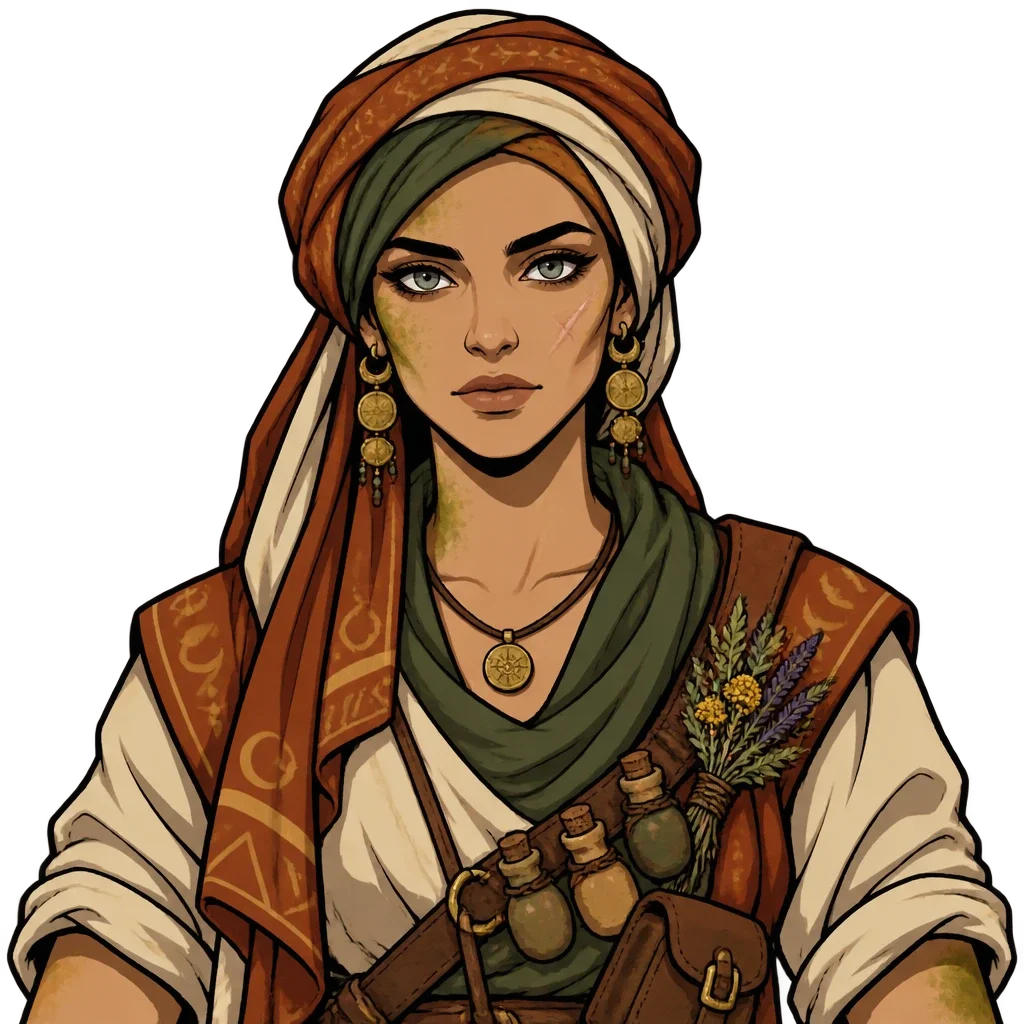 | Dunesong Apothecary (Herbs & Incense) Cooling draughts, antitoxin, poultices, and undead-ward incense rendered from rare Deadlands herbs harvested under moonlight. The Wardens swear by what the city calls "Neris's smoke." Owner: Neris Dunesong, a quiet apothecary with storm-grey eyes and resin-stained fingers. |
 | Nightwater Exchange (General Goods) Caravans and survival gear: waterskins, tents, ropes, desert kits, sun-compasses, and trade permits — everything needed to cross the Deadlands by starlight. Owner: Sahri Nightwater, a lean, sun-browned woman in a dusk-blue keffiyeh with quick, assessing eyes. |
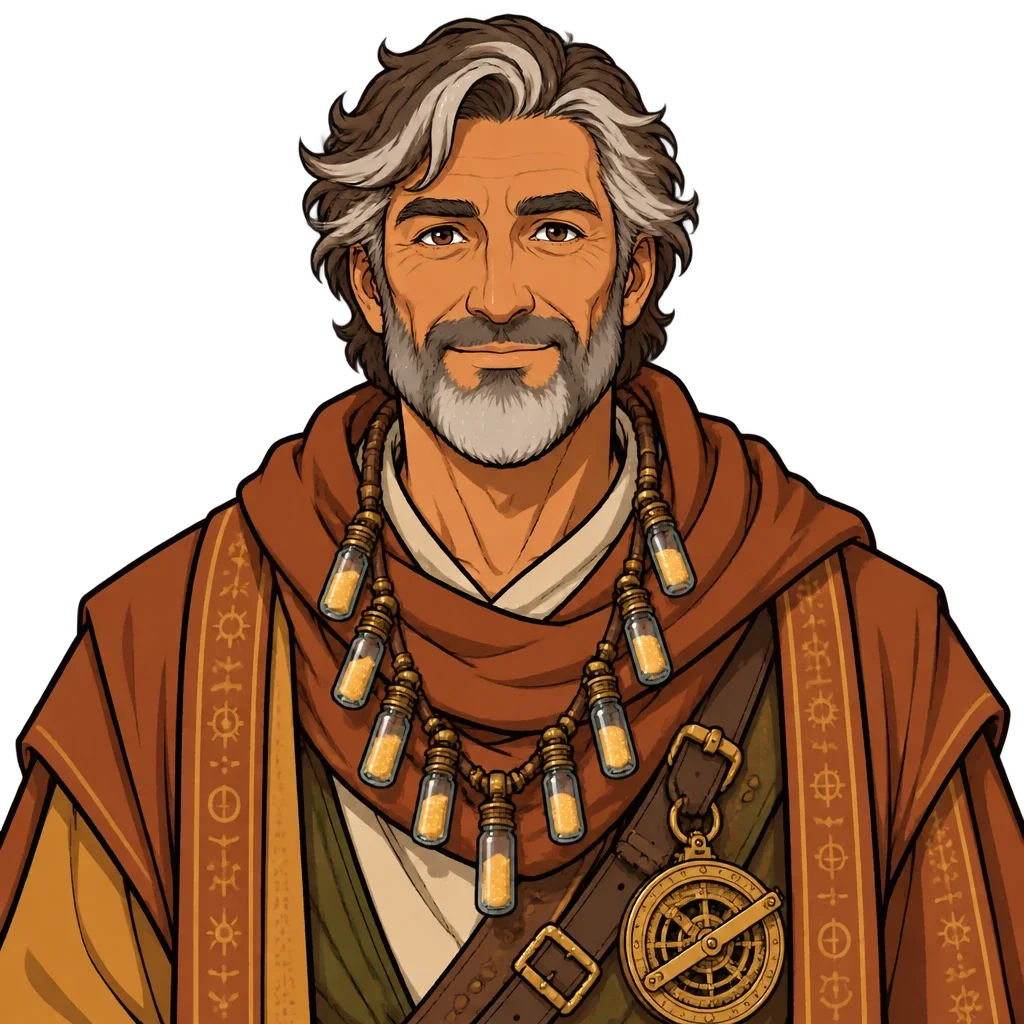 | Starglass Curios (Relics & Maps) Ruin-maps, brass astrolabes, sun-compasses, and curious fragments pried from half-buried halls of black stone — sold with a smile and a warning. Owner: Zahir Sandglass, a soft-spoken relic-dealer wearing a necklace of glass vials that glitter like trapped starlight. |
 | The Open Door (Inn & Bazaar) The bazaar-style inn of House Anuvesh — rooms by the night or the season, hot meals on long communal tables, hookahs in the courtyard, and a rotating gallery of small stalls run by guests, foundlings, and house members. The first roof every foreign-admitted resident sleeps under. Owner: Mama Sherahn, the unflappable Anuvesh matriarch who remembers every name that has passed her threshold. |